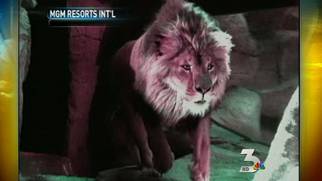
MGM closes lion habitat
Viewing video requires the latest version of Adobe's Flash Player
 digg
digg Facebook
KSNV coverage of the MGM Grand lion exhibit being shut down, Dec. 28, 2011.
Related stories
- MGM Grand's lion habitat to close Jan. 31 (Dec. 28, 2011)
- Las Vegas' free attractions for everyone to enjoy (July 28, 2011)
- Las Vegas lacks major zoo but abounds in specialty habitats (July 9, 2011)
When Terry Lanni and Alex Yeminidjian were handed control of billionaire Kirk Kerkorian’s struggling MGM Grand in mid-1996, they inherited a “Wizard of Oz”-themed property featuring animatronic versions of the 1939 film’s Tin Man, Cowardly Lion, Scarecrow and Dorothy in a megaresort version of The Emerald City.
Lanni, a longtime Strip casino executive, and Yemenidjian, a financial strategist, didn’t see the resort’s Oz-inspired Studio Walk display as a successful meshing of pop culture appeal and money-making potential. They saw a different dynamic in the free attraction: lost revenue per square foot.
Within months, the new management replaced the movie kitsch with a nightclub, a themed restaurant and bar, and slot machines — lots of slot machines. Revenue at the property’s Strip entrance jumped in the ensuing quarters, and “Terry-’n’-Alex” — as they became known to the Wall Street bankers and analysts who underwrote and monitored the Strip megaresorts of the 1990s — were lauded for the financial windfall from the renovation. Boom-era financial engineering trumped Depression-era movie nostalgia, and the company’s stock price was among the beneficiaries.
Fast-forward 15 years, and today’s MGM Resorts management team announced recently that the megaresort’s free lion exhibit, along with the Studio 54 nightclub, will be replaced by a restaurant and other amenities.
The changes are part of a $160 million makeover of the MGM Grand, where executives faced a common business decision along the Strip: whether to devote space that could yield dollars through gaming, dining or retail to attractions that don’t generate a penny directly but could bring consumers in through the door. Such attractions — waterfalls, nightly nautical battles, roller coasters and, yes, lion habitats — offer value by contributing to a hard-to-define measurement of a resort’s overall feel and appeal.
“Part of it is about revenue per square foot, but there’s also a broader measure of what any amenity or attraction contributes to the overall personality and success of a property,” said Alan Feldman, MGM Resorts International senior vice president.
The Bellagio conservatory, with its seasonal floral displays, could prompt financial analysts to question the wisdom of filling prime resort space with a massive display that generates limited direct revenue, gift shop earnings aside. It’s much harder to quantify the human appeal of such an offering and how that translates to visitors spending their money in the resort. The story’s the same for the Eiffel Tower at Paris and nightly pirate shows at Treasure Island.
Theoretically, the attraction is a key part of the brand, but how much and for how long? After all, one of every five visitors to Las Vegas during 2010 came here for the first time, according to figures compiled for the Las Vegas Convention and Visitors Authority. That means four of five likely had a chance to see the lion habitat during a previous visit.
“You can see the appeal to an attraction like that. I can see why it worked,” Professor David Schwartz, direct of UNLV’s Center for Gaming Research. “Obviously, they’ve made the judgment that it’s not working anymore.”
Remember the Middle Eastern-themed Aladdin? The space-age Landmark? The various iterations of the new, old and last Frontier? Executed properly, they might have survived with an appropriate mix of design, redesign and funding, but they’re all gone, relegated to the boneyard of black-and-white photos and neon signage. Nonetheless, they all — at one time or another — brought something to the bottom line.
“It isn’t carrying the brand of the MGM Grand,” Feldman said of the soon-to-be-shuttered lion habitat. “The brand rests on many other attributes.”
In fact, the demise of the one-time king of the MGM Grand jungle was announced with hardly a roar. Rather, the Las Vegas Sun was alerted by a corporate spokeswoman who requested that the newspaper pull all references to the lion habitat from a weekly events calendar. Asked why, the spokeswoman simply explained that the habitat would close Jan. 31. No hoopla. No major announcement.
“I don’t know that it needs a lot of fanfare,” Feldman said of the move. “Strategically, you reserve the fanfare for something that opens.”
Does the departure of the lion exhibit signal a move toward fewer free attractions on the Strip? Not so fast, industry experts say. Freebies will continue to be judged on a case-by-case basis for the value they bring to individual resorts, they say; so don’t expect them to go away as long as they’re drawing customers.