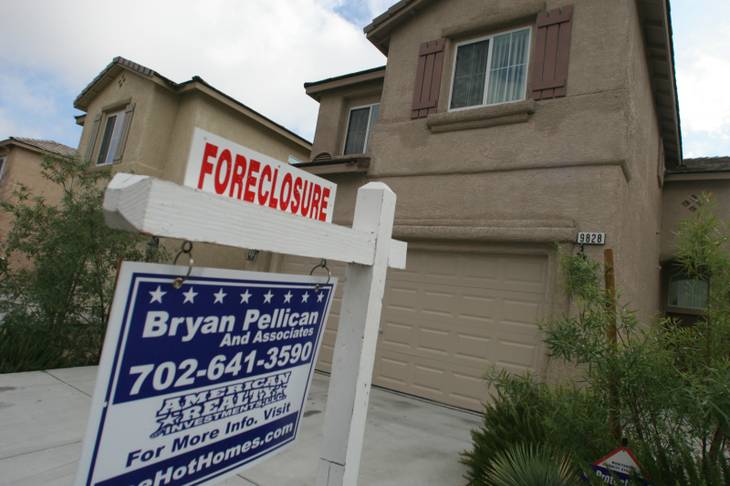
How low can they go?
Nevada’s existing home prices declined in March, and a jump in foreclosure filings and weak economy may push them down further this year.
A California-based firm, John Burns Real Estate Consulting, projects the 2011 median home price will decline 12 percent from a 2010 median price it tabbed at $135,000. That translates into about a $16,000 decline year-over-year.
Home prices had been stable for more than a year, but the end of a federal tax credit for first-time homebuyers last year has revealed a false bottom.
In March, the Greater Las Vegas Association of Realtors reported the median price of homes sold on the Multiple Listing Service was $125,950, a decline of $2,050 from February and down more than 7 percent from March 2010.
“Looking at our forecast for 2011, we are going to see prices fall in the resale market,” said Ken Perlman, vice president at John Burns Real Estate Consulting. “There’s still a lot of distress in the market. There’s a lot of inventory that hasn’t hit the market yet, and we’re going to have to work through that inventory. It’s going to be a challenge.”
Perlman said the firm projects 2011 sales will increase about 6 percent over 2010 because of the drop in prices that helps fuel demand.
By 2012, an improvement in the Southern Nevada economy with an increase in jobs should boost the median price by 8 percent over 2011, Perlman said.
National press coverage of falling home prices in Las Vegas is helping spur sales, because people realize the market is more affordable than it has been in years, said Dennis Smith, president of Las Vegas-based Home Builders Research.
There already is evidence of further price drops. The GLVAR reported that home listings posted in March put the average price at $132,000, a decline of nearly 12 percent from March 2010.
Smith said some investors sat on the sidelines during the fourth quarter to see where prices were heading. When they continued to decline, it boosted their interest, he said.
The 3,384 sales in March were up 31 percent from February and nearly 7 percent from March 2010. The GLVAR reported that 51.4 percent of all existing homes sold in Southern Nevada on the MLS were purchased with cash.
“They were just waiting to see if prices were going to go up or not,” Smith said.
Smith said he’s even seeing interest pick up in the new home market that has struggled since the end of the federal tax credit.
Builders have dropped prices and opened new subdivisions in recent weeks, and that’s boosted sales per subdivision from 0.2 to 0.3 per week at the beginning of the year to 0.4 to 0.5 per week in the last four weeks, he said.
Homes with troubled mortgages continued to dominate the market in March, with more than 71 percent either foreclosures or short sales, where the owner owes more on the mortgage than the home is worth.
After a brief lull in foreclosures because of a national controversy over lenders doing proper documentation, the problem is worsening in Nevada once again.
California-based RealtyTrac reported April 13 that foreclosure filings rose 35 percent in March over February, after two consecutive months of decreases. One of every 88 homes had a foreclosure filing, including 5,565 with a notice of default. That’s up from 4,178 in February.
The 3,761 homes foreclosed upon in March are up from 2,125 in February as the state retained its ranking of No. 1 in the nation.
Las Vegas also kept its No. 1 position as the foreclosure capital of the nation during the first quarter, with one filing for every 31 households.
The existing condominium and town home market mirror what’s happening with homes. The 932 sales in March were nearly 20 percent higher than February. The median price for those units was $61,000, a 2 percent decrease from February.