The Cosmopolitan of Las Vegas.
The Cosmopolitan opened in December 2010 during the depths of the Great Recession, and few expected it to be an immediate financial success.
Besides a stagnant U.S. economy that slowed visitation to Las Vegas, the casino resort faced several other, more unique challenges.
Its hefty $3.9 billion price tag was so high that observers wondered if owner Deutsche Bank could ever recover its investment. The bank completed the project after the initial developer of the Cosmopolitan defaulted on a development loan.
Lawsuits raged between the resort and people who had bought condominiums there. Buyers were trying to back out of their purchases because real estate values had declined.
And the Cosmopolitan’s opening capped a massive building boom on the Strip. Only a year earlier, the neighboring CityCenter flooded the market with 5,735 hotel rooms. The Cosmopolitan’s almost 3,000 units added inventory to a market already struggling with too many rooms because of the slowdown.
But the casino-resort survived, and now, approaching its two-year anniversary, many of its early issues have been resolved. Most of the condo lawsuits have been settled, and visitation to Las Vegas is rising.
In fact, the Cosmopolitan has successfully established itself as the city’s premier luxury resort — some call it a massive boutique hotel — for hip, affluent travelers who are more interested in restaurants and shows than gambling.
While gaming is king at many Las Vegas resorts, that’s not the case at the Cosmopolitan. Casino revenue there falls well below hotel, food and beverage revenue.
In February, it cut 40 jobs from its gaming department.
The property opened with an underperforming slot floor (which was expected since the Cosmopolitan as an independent company had no database of gamblers to market to), and its narrow footprint led executives to forgo a poker room.
However, because of increased volume in table game play, the resort recently added back 40 gaming jobs. The hiring appears to be driven by the success of the high-limit luxury Talon Club, which has 15 table games and was added in November 2011 to the Cosmopolitan’s second floor above the main casino.
As for finances, the Cosmopolitan has operated in the black, at least under one interpretation of its performance.
Under strict accounting rules, it lost $18.8 million during this year’s second quarter. But after factoring depreciation and amortization expenses, the resort generated $22.8 million in positive cash flow.
Net revenue for the quarter was up markedly, from about $126 million in the year-earlier period to almost $166 million. That was due, in part, to the completion of 968 rooms at the property.
And even after expanding its supply, the Cosmopolitan boosted its average room rate from $246 to $268 — well above the city’s $110 average.
Whether Deutsche Bank will ever earn an actual profit on its investment in the Cosmopolitan, however, remains to be seen.
It’s no secret that while the bank has provided the resort the financial resources it needs to compete, it likely won’t remain a long-term owner of the Cosmopolitan. Gaming is not Deutsche Bank’s main business.
When and for how much the property might be sold remain unknown.
“The Cosmopolitan is a financial investment, neither a long-term nor a strategic one,” said Mayura Hooper, a bank spokeswoman in New York. “The Cosmopolitan’s performance is on track with our strategic plan.”
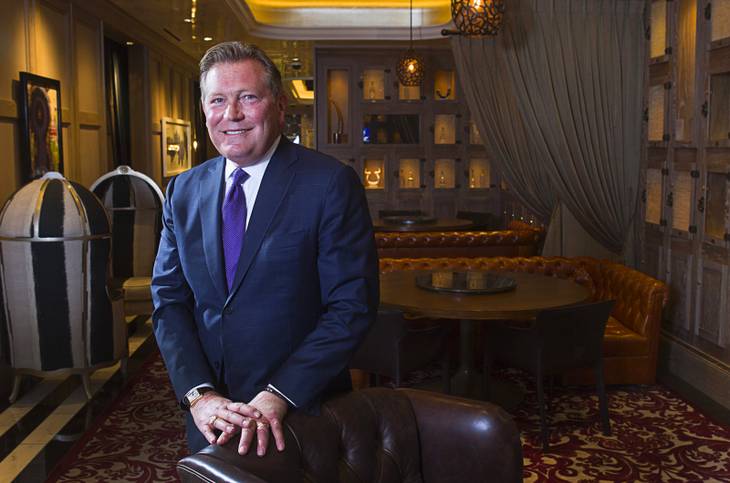
CEO John Unwin joined the Cosmopolitan’s parent company 14 months before the property opened. A 30-year veteran of the hotel industry, he came from Caesars Palace, where during a five-year stint he advanced to senior vice president and general manager.
Unwin recently sat down with VEGAS INC to discuss the resort’s achievements and challenges:
What has been accomplished in the two years since the Cosmopolitan opened?
One of the things we set out to do when we opened was to create trips to Las Vegas that would otherwise not happen. We’ve been successful in doing that. Trips from detractors and defectors, people who had checked Las Vegas off their list or who had never been here because of an image of what they thought Las Vegas was.
The other thing we set out to do was to be “different that matters.” We wanted to really stand out in a sea of sameness. I spent a lot of time in the year or so leading up to the opening explaining or trying to explain to people who were clients or media that we were going to be different. Everyone kind of nodded their head and said, “I’ve heard that before.” So it has been very satisfying over the almost two years to hear a lot of those same people come here and say, “It really is different.”
The Cosmopolitan is regularly recognized for cutting-edge entertainment and some of the best hotel, restaurant and nightclub offerings. Strong revenue also seems to prove their success. How did you accomplish that?
Primarily through experiences that are true to Las Vegas. They are done in a more modern and relevant way. It’s in our guest rooms that have a big-city feel, like a fantasy high-rise apartment in New York or Tokyo or Hong Kong with terraces where you can step out and engage with the Strip in a way you can’t do anywhere else. It’s the idea of all-new chefs, restaurants and retailers to the market. It’s reinventing the buffet. It’s not only to bring “new,” but to bring what people are interested in and to do it in a new way.
Who is the Cosmopolitan customer?
Our strategy from the outset was to target a psychographic rather than a demographic. We went after the curious class, which is not defined by age, race, gender or the typical demographic criteria. It’s defined by a mindset. A sense of exploration is important to these people. They’re interested in unique hotel concepts. They like foreign food. They like to read provocative periodicals and so on.
We look at how we penetrate the various markets. We do very well, for example, with Los Angeles, Phoenix, New York City, Miami, Chicago and San Francisco. We do very well in larger metropolitan areas.
People embrace that independent spirit we have. We do a lot more restaurant business with locals than I thought we would. Parking is easier than I thought it would be.
On the international side, our top markets are Canada, the United Kingdom, Germany, Australia and Mexico.
Asia is not on that list.
Asia, in terms of numbers of people, is not one of the top markets to this destination. In terms of value, it’s high value, and we do very well with Asia in terms of gaming.
We think there’s opportunity for us to grow that business, not only internationally but Asian domestically.
Gaming revenue at the Cosmopolitan lags significantly behind hotel, food and beverage revenue. But at many Strip properties, gaming is the main generator of profit.
Gaming is an important part of the Las Vegas experience. You want to play some casino games. You want to have a steak. You want to walk up and down the Strip.
Gaming is a very important element to the Cosmopolitan, and it’s an important element to our customers.
Table games from day one have been very successful for us. They’re so successful we opened the Talon Club last November. It has been wildly successful.
On the slot side, we always knew there would be a ramp period because we started with no database.
What we heard from our customers was, “You’re truly different when it comes to the hotel, restaurants and retail. Bring some of that Cosmopolitan spirit to the casino floor, particularly on the slot side.”
We responded to that by adding some special touches on the slot floor. We have casino concierges. We’ve gotten a lot of credibility for our mixology program. They make a special drink for the day, and they give it to people on the slot floor. We bring down some tastings from the Wicked Spoon Buffet. We’re focusing on attaining and retaining that customer. And we’ll stay focused on it. It’s an important part of our business.
Can the Cosmopolitan be profitable even if gaming continues to be a smaller portion of revenue?
Yes, absolutely. The financial trajectory is really powerful. With the forward-looking signs that we have, with convention bookings and room bookings and our ability to price rooms, I expect that trajectory to continue.
We came out of the gates at market occupancy and the highest average daily rate on the Strip, and that was very important to us because it was important to us to secure a position in the luxury premium tier. We came out of the gates with a grand slam on the food and beverage side.
We have more than 150 groups re-booked here for future meeting and convention business, so that tells me once they get exposed to the product, they like it.
Are you happy with the way the LVCVA markets Las Vegas, particularly for the luxury segment you’re in?
They do a really good job for the destination. We partner with them, particularly on the group and convention side. They organize a mission to somewhere like Mexico City, and we send one or two sales people that get to represent Las Vegas and the Cosmopolitan. In a way that, for an independent like us, I’m not sure we could do without their support.
The Culinary Union was recognized as the bargaining agent for a good number of your employees in April 2011, and talks have been going on quite a while. Is there progress in reaching a contract?
It’s a process that has a number of substantive issues. It’s happening in a respectful and positive way. It’s progressing at a good pace. We are on track to create a collective bargaining agreement that’s good for employees, that’s good for the union and that’s good for the company. That’s not easy to do.
Is the company in a position to increase wages and benefits, or do you need to hold the line on costs?
It would be inappropriate for me to talk about the specifics of the negotiations.
Is the Cosmopolitan applying for an online gaming license? Do you plan to get into Internet poker?
We have not applied. We’re closely monitoring the federal legislation. We continue to evaluate potential partners and the business opportunity.
I’m not sure that it makes sense for us in Nevada alone to put the resources into that. It’s not a huge market at this point.