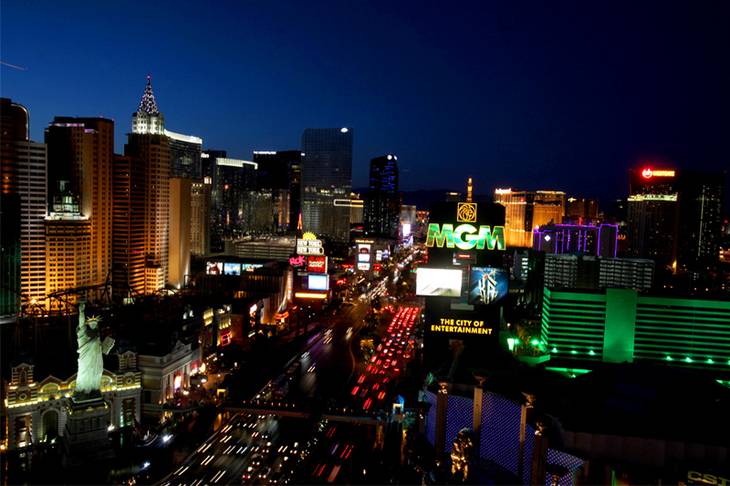
Money won from gamblers comprised a record low share of the Nevada casino industry’s total revenue generated during the past fiscal year.
But spending on food, beverages and related offerings produced an all-time high share of the overall revenue picture, according to figures released Friday by the Nevada Gaming Control Board.
The board's numbers support a much-stated contention in recent months: The state’s gaming industry is recovering from the depths of the recession but has yet to fully rebound.
“We’re seeing what we all kind of know,” said Mike Lawton, a senior analyst for the control board. "We’re seeing growth, but it’s a little different than we’re used to seeing. You’re seeing spending patterns changing and becoming much more event driven.”
The state’s gaming properties earned a record high 34.1 percent of their revenues from spending on “food, beverage and other (related offerings),” the control board reported. But gaming revenue sank to a historic low of 46.2 percent of the financial pie, a figure that stood as high as 60 percent in 1994.
The shift in revenue began after the 1989 opening of The Mirage and the property’s mix of non-gaming offerings, then accelerated with the 1990s construction boom that saw the opening of the MGM Grand, Bellagio, Venetian and Paris, among other megaresorts. The changing revenue mix was further intensified by the introduction of high-end restaurants and nightclubs in the late-1990s and production shows with average ticket prices of $100 a person.
“It’s a continuation of a trend that’s been going for a while, a case of more people coming and spending less money,” said Professor David Schwartz, director of UNLV’s Center for Gaming Research. “The casinos have to adjust to how they’re going to get by.”
Schwartz's comment about an increase in visitors is backed by the Las Vegas Convention and Visitors Authority, which has yet to release visitor numbers for 2011 but has reported that Southern Nevada was on pace to generate nearly 40 million visitors in 2011. The total could surpass the record of 39.2 million set in 2007, the LVCVA said.
Statewide, meanwhile, the 256 casinos recorded a $3.9 billion loss on gross revenues of $22 billion. The gross revenue figure was down 13 percent from peak levels of 2007, but up 5.6 percent from a year ago.
The 41 gaming locations on the Strip generated total revenue of $14.5 billion, or 66 percent of total state revenue.
Spending on hotel rooms dropped 15 percent from 2007, but consumer spending on beverages jumped almost 10 percent from the past year to $1.5 billion, which was up 7 percent from 2007.
“People are simply spending more in other areas,” Lawton said.
Overall, the 41 casinos on the Las Vegas Strip collected 9.3 percent more revenue in the fiscal year ended June 30 as compared with the previous fiscal year. But they still posted a $2.2 billion loss. It was the third consecutive year of a loss, but it was less than the $2.5 billion loss recorded in fiscal year 2010.
Total Strip revenues were up from $13.2 billion the previous fiscal year — the first increase in total revenues since 2007. But the casinos posted an overall loss due to increased depreciation, higher interest payments and other administrative expenses due to such factors as write-downs.
The room occupancy rate rose from 88.4 percent in fiscal 2010 to 89.1 percent, Lawton said. The average room rate increased from $112 per night in fiscal 2010 to $120 last fiscal year.
The 41 casinos in the balance of Clark County were another big contributor to the state’s total loss. They registered a $1.3 billion net loss for last fiscal year, with the decrease attributed to higher administrative expenses.
The 16 casinos in downtown Las Vegas posted a loss of $59.9 million, while the 31 clubs on the Boulder Strip reported a loss of $403 million.
Elsewhere:
• The nine Laughlin casinos showed a $654,872 loss.
• Casinos in Washoe County lost $44.5 billion.
• Casinos along the south shore of Lake Tahoe lost $24.7 million loss.
• Elko County, with its booming mining business, showed a $44.9 million profit from its casinos, an increase of 21.5 percent.
• Carson Valley clubs reported a $533,355 profit, up 222.4 percent from the prior fiscal year, when they were in the red.