REAL ESTATE:
Nevada moves to No. 2 on U.S. foreclosure list, behind Arizona
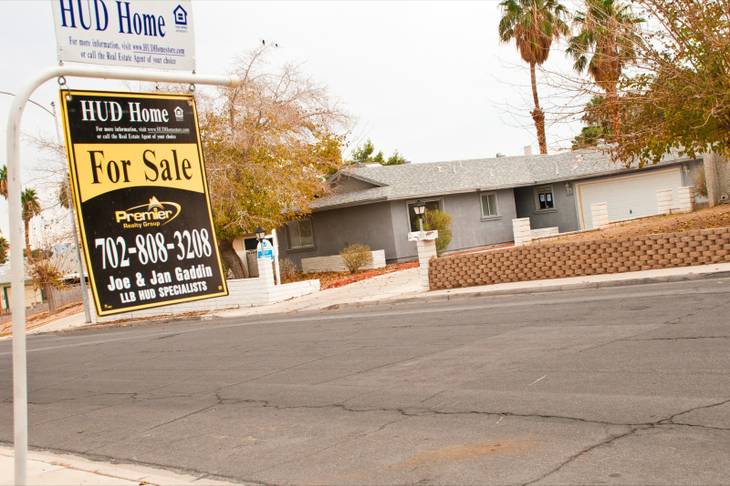
Two foreclosed and unoccupied homes in the 4500 block of E Sun Valley Drive sit across from eachother, Thursday Dec. 15, 2011. Organizations, such as PLAN and the Las Vegas Foreclosure Task Force, are pressuring the Obama Administration to reject the 50 state settlement with Wall Street banks.
Wednesday
11 April 2012
9 p.m.
Related content
A good-news, bad-news scenario emerged Wednesday on the foreclosure front in Nevada.
RealtyTrac of Irvine, Calif., which collects and analyzes foreclosure data, reported that in March, Nevada moved to No. 2 on the national foreclosure list after leading the nation for 62 consecutive months.
With one foreclosure filing for every 300 households, Arizona moved into the No. 1 spot in March, RealtyTrac said.
Nevada’s rate was one filing for every 301 households. California came in at No. 3 with one filing for every 303 homes.
All these numbers were well above the national rate of one filing for every 662 homes.
The bad news for Nevada, however, is that it led the nation in the growth of foreclosure starts in March, with filings jumping 153 percent from February.
That’s an indication that in coming months, completed foreclosures will also increase in Nevada.
It’s impossible to say by how much, as some homeowners may gain refinancing and banks may allow others to get out of their mortgages with short sales in which homes are sold for less than the debt against them.
In Nevada, 1,163 properties received default notices in March, up from 460 in February, RealtyTrac said.
Largely because of a new state law requiring lenders to file extra documentation with foreclosures, Nevada foreclosure filings dropped dramatically in late 2011 and now appear to be heading back up as banks have adjusted to the situation. There were 5,565 filings in March 2011, RealtyTrac said.
Among the nation’s metropolitan areas, Las Vegas ranked No. 8 on the first quarter foreclosure list, RealtyTrac said. Las Vegas had led the nation for 22 consecutive months until October.
Leading the nation in the first quarter were seven California markets: Stockton; Modesto; Riverside-San Bernardino-Ontario; Vallejo-Fairfield; Merced; Sacramento and Bakersfield.
For Las Vegas, the high unemployment rate (12.2 percent) continues to contribute to elevated levels of foreclosures.
Unemployment and foreclosures combined continue to depress local housing prices.
The Greater Las Vegas Association of Realtors this week said the median price of single-family homes sold in March was $123,000, up 1.7 percent from $121,000 in February, but down 2.3 percent from $125,950 one year ago.
Nationwide, RealtyTrac said foreclosure filings were reported on 198,853 properties in March. That’s down 4 percent from February, down 17 percent from March 2011 and the lowest monthly total since July 2007.
Declines in recent months have been attributed to efforts by banks to beef up compliance with foreclosure rules; as well as regulatory investigations, many of which are wrapping up.
''The low foreclosure numbers in the first quarter are not an indication that the massive reservoir of distressed properties built up over the past few years has somehow miraculously evaporated,'' Brandon Moore, CEO of RealtyTrac, said in a statement. ''The dam may not burst in the next 30 to 45 days, but it will eventually burst, and everyone downstream should be prepared for that to happen — both in terms of new foreclosure activity and new short sale activity.''
Share
Join the Discussion:
Previous Discussion:
Discussion 3 comments
Only trusted comments are displayed on this page. Untrusted comments have expired from this story.
Most Popular
- Nevada lawmakers ‘all over the map’ on immigration reform
- Police: Suspects in fatal robbery targeted, stalked teen with iPad
- Coroner: Woman killed in apparent murder-suicide was shot, stabbed, beaten
- Witnesses offer ‘sketchy stories’ about Henderson brush fire, official says
- Coroner ID’s 3 people killed in wrong-way freeway crash


Shocking news. Especially after such rave reviews from the GLVAR! Of course their job is to sell the market....even if it sucks.
In a traditional refinance, insist on a good-faith estimate of the costs up front, before you give the lender a penny, search the web for "Official Refinance" I would strongly recommend them. They got me 2.891% rate! It is good to learn more about refi before doing it.
The big difference between our state and Arizona is their entire federal bench is completely hostile to homeowners raising "where's my Note? who's the Note Holder?" issues. A couple years ago when the powers-that-be decided to lump all Nevada and Arizona MERS cases together for one big judicial resolution it was handed to Arizona's Judge Teilborg. This guaranteed all the homeowners would lose big, and they did.
Apparently their federal judges have replaced the Rule of Law with the Golden Rule -- whoever has the gold makes the rules. Prostitution is alive and well in Arizona federal courtrooms.
Nevada's Supreme Court cured a lot of this with last July's Pasillas and Leyva cases. Too bad Arizona's counterpart won't grow a pair and resolve it all to favor their victims.
"If you're going to take my house away from me, you better own the note." -- Joe Lents (who hasn't made a payment on his $1.5 million mortgage since 2002) in Bloomberg's 2/22/08 "Banks Lose to Deadbeat Homeowners as Loans Sold in Bonds Vanish"
People who claim the "where's the note" defense are greedier than the banks. Quote all the laws, all the loopholes you want but sensible people understand you bought a house, you signed on the note, you made payments to the bank and you haven't paid the note off in full - end of story. It's not your house, that much is clear.
If you didn't have a mortgage then why did you make payments to someone? If you paid it off then where are all of your cancelled checks/payoff letter? And, in fact, if you paid the mortgage in full YOU should have the deed. Again, if it was YOUR house then YOU would have the deed.
The banks may not know exactly who has the rights to your house (that's for them to sort out) but we all know that unless you paid off the mortgage you don't own it.
You're greedy - again - worse than the banks. And our City suffers while you live for free. Get out, the bank needs to sell that house to someone who is honest and will pay their obligations. There are deserving people out there who need a home.
"People who claim the "where's the note" defense are greedier than the banks."
Doug -- you've shown here how profoundly ignorant you are on this issue. The big question is why would anyone pay someone who refuses to prove they are who you owe? Enlighten yourself @ http://www.nytimes.com/2009/03/01/busine...
"Why don't the banks want us to see the paperwork on all these mortgages? Because the documents represent a death sentence for them..... in America, it's far more shameful to owe money than it is to steal it." -- an article from the November 25, 2010 issue of Rolling Stone by Matt Taibbi "Courts Helping Banks Screw Over Homeowners"
"The big question is why would anyone pay someone who refuses to prove they are who you owe?"
Because I'm not greedy like you. It's really that simple. That's why I pay.
I wouldn't ask the bank to show me the note. I know I signed the deal with my mortgage company (I was there after all you know) - I sat there, I looked them in the eye and I signed the agreement. So I will pay.
Look for loopholes all you want, knock yourself out. It's your life, your choices. But for my wife and I, we know we don't get to live for free. We know we signed a mortgage and we know we haven't paid it off. We don't want to steal from the bank so we'll pay.