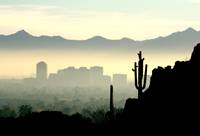
The Phoenix skyline.
Related Story
Las Vegas
- Population: 606,656
- Annual Days of Sunshine: 294
- Annual Precipitation (in inches) 5.6
- Major Employers: Nellis Air Force Base, MGM Resorts International, Las Vegas Sands Corp., Caesars Entertainment, U.S. Energy Department, Metro Police, Clark County School District
- Major Industries: Entertainment, Service industry
- Gross Metropolitan Product: $91,742,000.000
- Household Income: $55,113
- Median Home Price: $115,000
- 2010 Foreclosures: 1 in 9
- Unemployment Rate: 13.3%
- Number of Golf Courses: 14
Phoenix
- Population: 1,445,632
- Annual Days of Sunshine: 310
- Annual Precipitation (in inches) 9.14
- Major Employers: The State of Arizona, Wal-Mart Stores, Banner Health Systems, City of Phoenix, Wells Fargo, Apollo Group, Maricopa County, Arizona State University, Bank of America, Intel Corporation, JPMorgan Chase, US Airways Group
- Major Industries: Service industry, Trade, Government
- Gross Metropolitan Product: $190,725,000,000
- Household Income: $55,887
- Median Home Price: $125,000
- 2010 Foreclosures: 1 in 14
- Unemployment Rate: 8.7%
- Number of Golf Courses: 8
In the early 1980s, Phoenix suffered from insecurity. A dry insecurity, but insecurity nonetheless.
At the time it was the size Las Vegas is today — population 2 million — but hadn’t grown a big-city reputation to match.
The national media, when they bothered to write about the booming Sunbelt city, contributed to the self-consciousness — mocking it for undisciplined sprawl, an unruly political scene, communities of seniors cruising about in golf carts or its downtown, which could take cannon fire after nightfall without casualty.
I lived in Phoenix back then.
Years later, landing in Las Vegas after working on the East Coast, I had an odd sense of déjà vu — the desert heat, of course, but also the sense of civic insecurity. Only to my surprise, one source of Las Vegas’ lack of confidence was Phoenix itself, which by now had four major league teams (never mind their illustrious history of futility) and other big-city amenities glaringly absent in Las Vegas. Like the orthodontist living next door, Phoenix seemed a tad boring, but was doing much better than we were.
Early last decade Phoenix set in motion a widely praised plan to improve its downtown by building campuses for Arizona State University and a state medical school. Why wasn’t Las Vegas trying something similar? Looking at our neighbor, some concluded: We could never be Los Angeles, but we might have been Phoenix.
Both cities are limping through the Great Recession with high unemployment, foreclosures and slowing growth. But the sentiment crops up when Phoenix lands a big score, as it did this year with Intel announcing it will invest $5 billion in a new manufacturing facility, adding to the chipmaker’s 10,000 jobs in the Valley of the Sun. Or when Las Vegans head to the Mayo Clinic in Phoenix or Scottsdale to see a specialist or have surgery. Or when, after visiting, they ask why Las Vegas doesn’t have a real zoo or a world-class museum on par with the Heard or even one decent water park.
Yes, Phoenix envy is out there. The question is: Is Phoenix worthy of our envy?
Las Vegas and Phoenix are post-World War II creations. Airmen and soldiers sent to train beneath sunny skies fell in love with the desert and returned when the war ended. That’s more or less how my parents ended up there. An uncle of mine had trained at Luke Air Force Base during the war and returned to Arizona to try his hand at business. Dad and Mom followed a few years later, settling in sleepy Glendale. Our backyard was still bordered by farm fields when I entered kindergarten in 1972. But the signs of growth were everywhere. My grade school classmates all seemed to be from the Midwest. They wore Green Bay Packers T-shirts and called the drinking fountains “bubblers.” And the summer storms that Phoenicians grandly call “monsoons” were preceded by walls of dust blowing through the neighborhood. The desert was being dug up and built over at a frantic pace.
Phoenix and Las Vegas lacked the established institutions and industries of points east. But for some that was the appeal. Las Vegas and Phoenix represented possibility. And as the cities grew — fed by the country’s decades-long population shift West and South — so did those possibilities. Real estate and construction were, until mere moments ago, safe bets. You could always sell that house to some soul who tired of shoveling the driveway and scraping ice off his windshield.
Phoenix has always been the bigger of the two cities. It had some genetic advantages. As the state capital, it was the hub of Arizona’s economy, which was memorialized in the five Cs — Cattle, Copper, Citrus, Cotton and Climate (the last C being tourism and growth by another name) — on the state seal.
Las Vegas, far from Carson City, was a political afterthought and a place to be pillaged by northern power brokers. This stunted its infrastructure. Economically, Las Vegas was a one-trick pony: legal gambling. But Las Vegas rode that horse with remarkable skill and endurance. The result: Greater Phoenix has more than 4 million residents today (Phoenix proper at nearly 1 1/2 million is the nation’s sixth-largest city), yet it’s Las Vegas with half the population that’s an international city and the global capital of gaming.
Robert Lang, director of Brookings Mountain West at UNLV, has taught in Europe. He enjoyed giving his students a quiz, showing them photographs of skylines from around the globe. Slipped among them was Phoenix’s. No one could ever identify it. “Only the newscasters who sit in front of the pictures of the Phoenix skyline know what it looks like,” Lang says. So which city, Phoenix or Las Vegas, should be the object of envy?
People who have lived in both cities say one thing about Phoenix stands out: Despite its size, it still has ambition. Maybe that’s what the insecurity of the 1980s has become. When the 49-year-old Phoenix Zoo, a beloved landmark, embarked on a recent capital campaign, it was with this slogan, “A world-class zoo for a world-class city.”
Dale Erquiaga, a native Nevadan, has seen both cities from the inside. He was an executive with Howard Hughes Corp. and R&R Partners in Las Vegas, then moved to R&R’s Phoenix shop before striking out on his own. Now back in Nevada, he’s senior adviser to Gov. Brian Sandoval. Of Arizona, Erquiaga says, “For a younger state, their business cohesiveness is more mature. They have a vision of things to do. Sports arenas? Theirs are built. And they have really leveraged downtown redevelopment. The feeling was it had to be a major metropolitan city — they brag about being the sixth-largest city. They’re proud of being a city.”
No doubt Las Vegas strives. The Strip wasn’t built from Mojave sand without ambition. But Las Vegas has been more driven by growth itself than vision. “Las Vegas grew so fast that there wasn’t that same coming together,” Erquiaga says. And when Las Vegas reaches, it’s usually a corporation doing it on behalf of shareholders. No alliance of Las Vegas business and university leaders ever successfully set about building an urban core. MGM unveiled its version, CityCenter, at a news conference. Beyond the Strip, Las Vegas is content with the role of Los Angeles suburb — the Lakers and Dodgers are home teams. Always the striver, Phoenix sees Los Angeles as its rival. At any moment, anywhere in Phoenix, the chant “Beat LA” is liable to break out. “I think we have a real sense of place on the Strip,” Las Vegas architect Eric Strain says. “But outside that we’re still looking for who we are and what we want to be. Phoenix has more of a sense of that.”
Part of it is a “greater appreciation and acceptance of the desert, living in the desert,” Strain says. “They have a larger population that was born and raised there so they’ve come to accept that when it’s 110 degrees they can still live outside. They have summer festivals and people swarm to them. We tend to want to leave when the summer arrives.”
Phoenix also has taken more care in the design of its public buildings and public spaces, Strain says. Libraries and schools are “strong visual community assets.” Even its freeways are decorated with public art and landscaping that reflect the surrounding area. Las Vegas is plagued by too much repetitive architecture beyond the Strip. “We’ve grown so fast that we just need things. It’s much easier to build 10 of the same design rather than have 10 different designs. Our schools have been the biggest example of that. Their communities really do gather and their schools and libraries become icons of that community. It’s harder for us to say that when my high school looks exactly like your high school.”
This may seem to Las Vegans like the product of better leadership and better vision on Phoenix’s part — and it is. But it’s also a product of the cities’ economic realities. Barry Broome, president and CEO of the Greater Phoenix Economic Council, a regional economic development organization, says without a big draw like legal gambling, Phoenix had to scrap to build and diversify its economy. “From the beginning, Phoenix was mining and agriculture, Las Vegas was Sin City,” Strain says. “You quickly became an entertainment mecca. We had to work harder to build an economy. As a result, we put a bigger emphasis on industry in the 1940s and 1950s and paid more attention to industries as they evolved. Phoenix built semiconductor, aerospace and electronics sectors. We’ve been successful in the renewables and clean technology sectors.”
The five Cs only take you so far, and they weren’t going to take Phoenix into the 21st century. For that, the city needed a research-based economy. Here’s where you learn that Arizona isn’t as conservative as portrayed on cable news. Its voters have supported bold initiatives and higher taxes to pay for them — for university expansions, economic development efforts, light rail — when they see a potential economic payoff or an important step to being a world-class city. During the past decade, Phoenix and the state contributed more than $1 billion to seed a bioscience and research-based economy.
Economic development officials say the effort has begun to bear fruit. In the process it has begun to remake downtown Phoenix, now home to the city-owned Phoenix Biomedical Campus; Translational Genomics Research Institute (TGen), a nonprofit organization dedicated to unraveling the genetic components of diseases; and a campus of the state’s medical school. Last year, the Biomedical Campus landed its first for-profit company, VisionGate Inc. The company, which is developing cancer diagnostic technology, moved its headquarters from Seattle to Phoenix. What drew the company from the temperate, coffee-fumed climes of Seattle? Its CEO joined research efforts at ASU, where he was named director of the university’s Biodesign Institute.
This was the kind of event that Michael Crow promised when he left his post as provost at Columbia University in 2002 to become president of ASU. The city needed higher education infrastructure to fuel economic diversification and to stop sending the state’s best and brightest to study elsewhere.
Sound familiar, Las Vegas?
Crow promised to build the “New American University,” woven into the community, accessible to more students and tasked with improving the economy through innovation and entrepreneurship. “A university’s reputation is determined by its research capability,” Crow often said. And ASU has doubled its investment in research over the past six years and added 1 million square feet of research space, including the Global Institute for Sustainability. ASU is in preliminary talks with the Mayo Clinic, which has a hospital in Phoenix and clinics in Scottsdale and elsewhere, on development of a joint medical school. As the Phoenix New Times put it, Crow “ruined what was traditionally a perfectly good party school.”
Crow has his critics, of course. Budget cuts and tuition hikes will do that. And some say by admitting more students — 90 percent are accepted — he is erring on the side of quantity over quality. ASU’s student body is more than 70,000 at four campuses.
Part of the vision to seed research and innovation was a downtown campus for ASU. The university refurbished a 1930s-era post office and built sleek modern buildings to house a growing number of programs — journalism, nursing, public programs and the university’s public television studios — drawing about 14,000 students to the area. The law school also plans to move downtown, the heart of the city’s legal community. ASU’s rival, the University of Arizona, plans to develop a 250,000-square-foot Arizona Cancer Center in downtown Phoenix. In late 2008, a light rail system, financed by voter-approved sales tax increases and federal funding, opened between downtown Phoenix and Tempe.
Strain, the Las Vegas architect, spent time in downtown Phoenix recently and was struck by the transformation — still a work in progress. People were milling about and lounging in cafes and restaurants. They’re “starting to have an actual urban lifestyle. People are living down there now so they’re looking for that kind of thing.”
If there’s one thing Las Vegas should envy about Phoenix, it’s the willingness to invest in higher education and understanding that it’s key to a city’s success in the new global economy.
Nevada’s reluctance to do the same has left Las Vegas with a higher-education infrastructure on par with much smaller communities — Flagstaff, Ariz.; Logan, Utah; and Las Cruces, N.M., Lang says. “My envy is ASU — that’s what Phoenix got right,” he says. “They went to (the University of Arizona in) Tucson and said we need to borrow that medical school and the research associated with it, and they used it to seed a biotech industry. They put the money in and built that capacity that we don’t have in Las Vegas. But they had to. They didn’t have a gaming industry. And they knew their economy had to move away from retirees, master-planned communities and golf courses.”
Even if they had to, leadership was still needed. Crow has provided it. Former Gov. Janet Napolitano did too, making economic diversification a focus of her administration. Napolitano left office in 2008 to become homeland security secretary. But it has come from less obvious sources, too. On downtown redevelopment, former Phoenix Suns owner Jerry Colangelo and leaders in the legal community helped lead the way. A new downtown arena for the Suns, along with retail and theater were the pioneers in the early 1990s. Then came Chase Field, home to major league baseball’s Arizona Diamondbacks, more theaters, a new city hall and a courthouse.
Broome makes a rapid-fire list of the renewable energy companies setting up shop in the Valley of the Sun: First Solar is building a 4 1/2 million-square-foot facility in Mesa; Power One is opening a manufacturing plant in Phoenix; Suntech Power, China’s largest solar panel manufacturer, built its first US plant in Goodyear and is boosting its output. Las Vegas is having solar success, but not on this scale. “Once you build an economy around technology, your economy is more recession proof and sustainable,” Broome says. “And it adds to your reputation beyond just being a Sunbelt economy where it’s just about the weather.”
There’s that word you had to know was coming: reputation. If Phoenix is the orthodontist next door, then Las Vegas is the stripper mom at the PTA meeting. Phoenix benefits from being boring. Las Vegas suffers for being quite the opposite.
“ ‘What happens in Vegas, stays in Vegas’ is such great branding,” Broome says. “But when you think about building an environment where you’re trying to attract talented people, you can’t be home to “The Hangover” and high-tech at the same time. I think that’s a tough sell.”
But Phoenix has some branding issues of its own that could benefit Las Vegas. Arizona’s tough immigration law, although prompted by legitimate concerns over the cost of illegal immigration, brought a swift national backlash — canceled conventions and threats to boycott Arizona-based businesses. Some estimated the value of lost business at nearly $100 million. “Anyone who says our image has not been hurt is living in a bubble,” Phoenix Mayor Phil Gordon said amid the peak of the controversy last year. In signing the law, Republican Gov. Jan Brewer was winning over her party’s immigration hawks but losing its business wing. Broome and Brewer had a major and public falling out over the issue.
The genuinely disturbing image of intolerance isn’t one that the people who run renewable energy companies want to be associated with. In that regard, Lang says, Phoenix could learn from Birmingham, Ala. During the civil rights era, Birmingham and its rival Atlanta were roughly the same size. However, Lang and William Brown, director of planning and communication at Brookings Mountain West, noted in an op-ed published last year in the Las Vegas Sun that Birmingham was the scene of racial clashes seen nationwide on network television news and became synonymous with Southern animosity toward blacks. Atlanta, on the other hand, called itself “The City Too Busy to Hate” and by reassuring Northern companies that it was more tolerant, grew into the global city it is today.
After the draconian immigration law passed, Broome heard numerous concerns from Intel and many others. He says that’s fading as other states pass similar immigration laws. But it’s clear that he wants to make sure the state’s sending the right message on this sensitive issue. “Our most important concern is to make sure our young state continues to grow and that the Latino community is as much a part of that as the Anglo community. We have to be careful to maintain cooperation between people of different classes and races. We don’t want to damage our reputation. But we don’t want to ignore the problem either or let the federal government off the hook for not doing their job securing the border.”
As Arizona does damage control, Las Vegas can offer California businesses a “more tolerant alternative to Arizona,” Lang wrote. “Fair or unfair, the decision to locate industry can come down to perceptions of tolerance.”
Where does this leave Las Vegas?
We have the profile and brand equal to the world’s capitals. But we don’t have a true city to match. The past half century has brought what Lang calls a kind of catastrophic success, where growth driven by gaming’s accomplishments was so overwhelming that it left glaring gaps in the development of the city’s infrastructure.
Can Las Vegas tap its profile to transform into a thriving place where corporations and the people who work for them want to live? That’s the billion-dollar question. Or to be more precise, the $2.3 billion question — that’s the size of the hole blown through Nevada’s budget by a recession that has shaken the swagger right out of the state.
Still, for all of Las Vegas’ challenges, Lang wouldn’t trade places with Phoenix. Las Vegas may have fallen to third in global gaming revenue, but the city’s expertise in that industry makes it “the most important and globally reaching city in the region,” he says. “There are some assets around here I’d never trade away.” So Macau and Singapore have surpassed us in gaming revenue, “but who’s the largest operator in those markets? Sands.” Houston remains the capital of energy finance, exploration, trade, refining and specialty services even though Texas is no longer a major energy producer. Las Vegas can remain the capital of gaming, serving as the worldwide expert. “We’re the first large-scale region to focus on gaming and entertainment. Now we control the development of that around the world. Phoenix has nothing like that. They may make chips there but it’s not Silicon Valley. It may have biotech but not like San Diego. They’re not headquarters for anything.” In that regard, they should envy us.
If our success was in some ways a catastrophe for the community, Strain sees the current economic catastrophe as an opportunity for another kind of success. “I think the bad economy has been a very positive thing,” he says. “People aren’t looking to relocate and trade up when they buy a home. They’re looking at it as a home. People are talking a lot more about community and what they want. This pause has given us time to reflect on what we want as a community.”
Meanwhile, Las Vegas is beginning to build some of the big-city amenities: The Smith Center for the Performing Arts, the Cleveland Clinic Lou Ruvo Center for Brain Health, the beginnings of an urban downtown on Fremont Street East. The city is starting to fill in the gaps. And if Lang is to be believed, there’s much more to come.
“Some of this is about reaching a certain population threshold,” he says. “Phoenix is significantly larger. We’re at 2 million now. So let’s see what we do now.”
But it’s more than mere population numbers. If you don’t plan it and push for it and pay for it, it doesn’t happen. UNLV won’t automatically become a great university. Clark County schools won’t turn around on their own. Zoos and water parks and libraries won’t build themselves.
People will strongly disagree on whether Phoenix has reached its goal, but it wants to be a great city. A large share of the population has bought into that lofty dream.
Las Vegans would like to have a city with thriving public institutions we can rally around. We would like robust art and music scenes and infrastructure that brings a sense of place, not mere function. But do we have the same ambition? Or are we here for the short term, until we cash out and move on?
Something Broome said about Phoenix’s growth pains kept coming back to me. Once a business is interested in moving to your city, the amenities, if you want to call them that, are overstated as far as closing the deal. Executives have concluded that the location and the various costs pencil out. Those factors will likely decide whether they move. But once a business has moved and its employees are living that decision, amenities become the most important factor in the business deciding to stay and expand.
Las Vegas must build a city for its residents, not for shareholders. It will make us more prosperous, as counterintuitive as that may seem.
Phoenix made it happen. Let’s stop envying it and start emulating it.