Related Story
Inside the Cosmopolitan
Viewing video requires the latest version of Adobe's Flash Player
 digg
digg Facebook
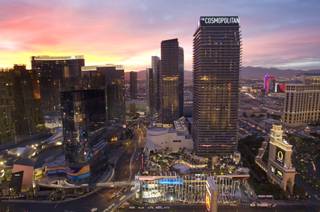
Get an inside look at the last resort to open on The Strip for the next few years. The Cosmopolitan of Las Vegas seeks to appeal to "the curious class," from a "restaurant neighborhood" with a secret pizza joint to its unprecedented number of rooms with outdoor terraces. The Cosmopolitan opens its doors Dec. 15, 2010.
By the Numbers
- Opening: Dec. 15, 2010
- Groundbreaking: Oct. 25, 2005
- Initial cost estimate: $1.8 billion (Oct. 2005)
- Final Cost: $3.9 billion
- Land: 8.7 acres between CityCenter and Bellagio
- Strip frontage: 335 feet
- Permanent jobs: About 5,000
- Rooms: 2,995
- Rooms with terraces: About 2,200
- Casino size: 100,000 square feet
- Restaurants: 12
- Bars and lounges: Four
- Nightclubs: One
- Retail space: 36,000 square feet
- Convention space: 150,000 square feet
- Spa: 43,000 square feet
- Pools: Three
Archives
- Cosmopolitan throws open doors to public right on time (12-16-2011)
- Cosmopolitan loses $56.8 million in first quarter (5-13-2011)
- Cosmopolitan opens high-roller suites to public (5-12-2011)
- Cosmopolitan named to Conde Nast Traveler’s Hot List (4-12-2011)
- Cosmopolitan owner expects to recover investment in resort (3-30-2011)
- Strip room prices no drag on Cosmopolitan's rates (3-14-2011)
- Cosmopolitan targets ‘curious’ tourists (12-12-2010)
- From art to dining, Cosmopolitain aims to be 'accessible and fun' (12-12-2010)
- CEO Unwin says resort’s indie spirit, novel offerings will set the property apart (12-12-2010)
- Steve Friess: A fitting end to Vegas boom era (12-12-2010)
- Staff putting finishing touches on Cosmopolitan (12-3-2010)
- New Year’s at Cosmopolitan: 1 room, 3 nights, $5,600 (12-2-2010)
- Cosmopolitan launches six-part video series ahead of Las Vegas Strip opening (11-30-2010)
- Killers frontman Brandon Flowers to highlight Cosmopolitan’s opening night show (11-8-2010)
- Cosmopolitan chief reveals more details about new resort (10-28-2010)
- Cosmopolitan’s jarring ad aimed at the ‘curious class’ (10-22-2010)
- Cosmopolitan announces lineup of stores, boutiques (10-20-2010)
- Cosmopolitan CEO plans to steal customers from Strip competitors (8-22-2010)
- Cosmopolitan resort-casino unveils Strip marquee (8-3-2010)
There’s little doubt about where the place to be is in Vegas on a Saturday night lately. If it’s early, it’s at Vesper Bar, where you sip a Moscow Mule and watch the beautiful people check in while you check out one of the floor-to-ceiling video art installations—perhaps the one of the couple dancing that could be a dreamy scene in "Mad Men." If it’s a little later, it’s small plates at Jaleo, with its self-proclaimed “world’s best gin and tonic” and the mosaic behind the bar that’s like a Vegas Botticelli. Or still later, at the Chandelier, where a woman in a dress made completely of feathers is eyed until the next spectacle wanders up the curving staircase. By 2 a.m., the place to be is Marquee, where the soundtrack will be the best cutting edge DJ from Germany, and the music won’t stop until after sun-up Sunday.
It’s all at the Cosmopolitan, which is making broad swaths of the rest of the Strip feel like the home of Orange County mooks, Tommy Bahama nobodies and fanny-pack hordes.
And Cosmopolitan has the crowds and the room rates to prove its coolness quotient. On an average weekend night, Marquee hosts four to five thousand. Scott Conant, celebrity chef at Scarpetta, tells me he has done 400 covers on some nights and had to send people away. As of mid-May, the weekend asking rate for June was $501 per night—tops in the city.
“The Cosmopolitan definitely did create a buzz and continues to maintain it,” says Robert LaFleur, an analyst with Hudson Securities.
The Cosmopolitan is the property, like the Mirage, Hard Rock and Palms in earlier times, that has finally revived the old Vegas rule that supply can create its own demand, that a new resort can deliver a snort of adrenaline to a boulevard in need of constant reinvention.
“Vegas needed a win, and this is a win,” LaFleur adds.
The only problem? The place lost money in the first quarter. A lot of money. And it cost $4 billion to build. And therein lies the challenge, not just for the Cosmopolitan, but for the rest of the Strip, as well. The newest generation of upmarket travelers has its own tribal tastes and mores, which raises the question: Can what’s cool now also be what’s profitable?
Before we get to that question, let’s explore what precisely it is about the Cosmopolitan that makes it so different than everything else.
Think in terms of Hollywood movies, of the same product chasing the same demographic. Then along comes something fresh that appeals to a different crowd. Like, say, "Black Swan," which, even before Oscar time, had delivered a whopping 1,323 percent return to investors.
If the rest of the Strip can sometimes feel like the same movie, the Cosmopolitan is "Black Swan."
The film business is an apt analogy, and not just because Cosmo denizens are likely fans of "Swan" director Darren Aronofsky. David Rockwell and his firm the Rockwell Group, which designed the Cosmopolitan, has done sets for theater productions such as "Dirty Rotten Scoundrels" and "Catch Me If You Can" as well as the Oscars. He once described approaching his projects as unwritten scripts.
I asked him what the script at the Cosmopolitan says.
He says his goal was something new that celebrates, in an age when so many of us stare at screens all day, both three-dimensional spectacle and dynamic interaction with friends and strangers.
Now listen to how the design dovetails with the Cosmopolitan’s marketing strategy, as explained by Lisa Marchese, senior vice president of brand marketing: “People trade in social currency. We wanted them to have stories to take home.”
This may sound like a bunch of pseudo-intellectual blather, but it’s hard to deny that what our resorts must do is create memories, stories that people tell themselves and their friends. If they don’t have an interesting story to tell back at work on Monday morning, there’s a decent chance they won’t return.
To create excitement, Rockwell turned what many thought of as a weakness—the property’s small, 8.7-acre footprint—into a real strength. Most casinos are warehouses, football fields of tables, slot machines, wandering drunks. At Cosmopolitan, in case you haven’t been, everything is actually jammed together, but on several levels.
“I thought the verticality was an asset. You want to go level to level,” Rockwell says. He tells me he absolutely loves riding the escalators from floor to floor.
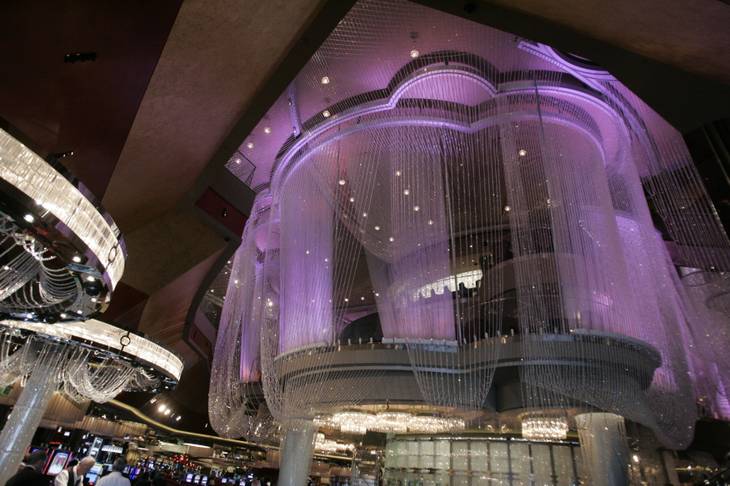
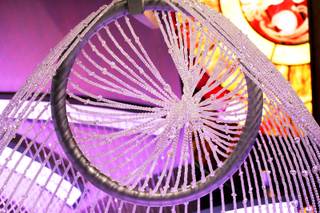
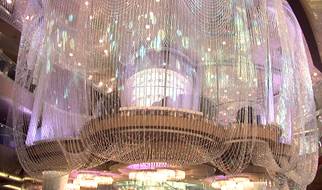
Then the big brainstorm—an object at the center that embodies what the place is about. A 45-foot chandelier that’s also like a tree house with a bar on each level. “A chandelier has sparkle, and your perception of it changes constantly depending on the light and where you are. And it’s a symbol of celebration. It would be the ultimate people watching place and have an urban sensibility,” he says.
And like exploring a big city for the first time, the Cosmopolitan offers surprises. And there are quite a few of them, especially for a casino. The vending machine with miniature art pieces (Art-O-Mat). The pool tables in common areas. The rooms with the Phaidon books and the now famous terraces that offer panoramic views. The restaurant “porches” that give a feeling of open cafes. The hidden (and delicious) New York City-style pizza joint with Pabst Blue Ribbon to boot. At the free Book and Stage, the indie pop of Best Coast, the bluesy jams of Robert Randolph & The Family Band and soul stylings of Fitz & The Tantrums. Or, Girl Talk, the mashup DJ of the moment, spinning a show at the pool, which works surprisingly well as a converted music venue.
Another big surprise about the Cosmopolitan: Locals are flocking to the place. I’ve been a number of times for work or concerts, and nearly every time I run into someone I know, including on Christmas Eve. I knew something was up when Vegas native and downtown lawyer and advocate Dayvid Figler told me it was the first place he and friends were going to on the Strip regularly since they inhabited a tiki place at the Venetian more than a decade ago.
And the biggest surprise of all about Cosmopolitan? No Cirque nor magicians nor impressionists nor past-their-prime rockers nor country nor pop stars. And no Prada. And no chefs who phone it in at some other resort. You know why? This will sound pretentious, but I’m pretty certain this is the Cosmopolitan’s thinking: Those things are no longer cool if they ever were. Or as Marchese delicately puts it, for certain people, Vegas “wasn’t relevant.”
Even Marquee, the hot spot most vulnerable to lowest common denominator thinking because of its potential to be a cash cow as a superclub, has gone off in a surprising direction by choosing cutting-edge electronic music over hip-hop and top 40. On a Monday night this year, I saw people who looked like they might be veterans of the Burning Man art festival in the Black Rock Desert in Northern Nevada.
But even when it went against the grain, Marquee managed to hit the zeitgeist dead on, as Vegas has suddenly become one of the leading locales for superstar DJs.
Rich Wolf, co-founder and principal of Tao Group, which manages Marquee, tells me he and his partners just had a feeling about it and wanted to “tap into the next wave.”
“We were told we would fail and end up abandoning the format. But to the contrary there’s more house music than ever. We felt the time was right,” he says.
Wolf says this insight came from traveling to major party spots around the world, where progressive house music is dominant, but where clubs often feature several musical experiences in different rooms.
That’s how Rockwell designed Marquee, with several rooms, including the Library, which has a fireplace, shelves filled with books from The Strand in New York—pointless? yes, but a sign of obsessive detail—pool tables and hipster rock and electro-pop that you might hear in cool Williamsburg, Brooklyn.
Tao Group operates Tao at the Venetian and Lavo at the Palazzo, but I can detect Wolf’s favorite spot.
“The hotel has the air of a super sophisticated party place that was lacking in Las Vegas,” Wolf says. “The formula has worked, and Las Vegas sorely needed it.”
The formula has certainly worked for Marquee, and, thus, for Tao Group, but has it worked for the unlikely owner, Deutsche Bank?
Here’s where it gets tricky.
For all its success, Cosmopolitan’s path to profitability is hazy.
In the first quarter, it lost $56.8 million on revenue of $105 million, or less than half of what Aria and Bellagio pulled in. Some of that could be attributed to comped rooms, drinks and meals of $22.5 million, and the fact that despite high occupancy and room rates, the full inventory of rooms—2,995—won’t be online until late summer, according to an SEC filing.
Here’s the composition of revenue: Room revenue of $34.4 million; food and beverage revenue of $57.6 million and, $31 million in gross gaming revenue.
This means just a quarter of the resort’s revenue was from gaming, significantly lower than the Strip average of 40 percent.
I talked to a number of rival operators and consultants, to whom I granted anonymity so they would speak candidly. They tend to take the view that Cosmopolitan is an interesting space that’s great for Vegas but can never succeed without hordes of the mathematically ignorant, aka, gamblers.
“Unless they can attract more gamblers, they’re going to have a tough go of it,” one says.
A gaming consultant scoffs, “Without gambling, it’s a $4 billion hotel, and how does that work?”
Lafleur, while praising the Cosmopolitan for its early buzz, agrees that gaming revenue must rise: “They’re getting people into the clubs and the rooms, but not the tables or the slots. That’s going to be the very difficult challenge—to drive that gaming business while not affecting the important buzz.”
Indeed, a source at a rival operation suggests loosening the slots and going to single-deck blackjack and other gimmicks and then advertising those gimmicks heavily. To me this seems like a terrible idea that would ultimately damage the brand.
Lafleur concurs while noting that this is the Cosmopolitan’s essential dilemma: “That’s the double-edged sword. You want the beautiful people, but you need the fanny packs. There aren’t that many 20- and 30-somethings who give your place a nice vibe and a nice look and you need those people to lose money.”
The Cosmopolitan’s serious gambling problem would seem to be threefold: Informational, architectural and demographic.
The resort is a stand-alone property without the sophisticated database of gamblers so prized (and necessary) by the big players.
Analysts and operators marvel at the effectiveness of Caesars Entertainment’s program, which enables it to lure its best customers nationwide to their local casinos and then occasionally rewards them with a trip to Vegas, running them in a beautifully profitable circuit.
Marchese, interestingly enough, held a similar position at Caesars, or, as it was known then, Harrah’s.
She says Cosmo’s partnership with Marriott gives the company access to a huge and strongly loyal customer database, though those aren’t gamblers, per se.
Marchese also says by starting from scratch, Cosmopolitan’s rewards program, called Identity, which rewards for gaming and nongaming spending, could be designed as a new, superior product. She declines to give specifics, but says growth is strong.
As always, time will tell.
The second problem, industry people say, is Cosmopolitan’s architecture. Much of the cool stuff is on the second and third floors, where there’s no gaming to speak of.
This is probably why locals hang out at Cosmo. It’s a real public space without the maddening clatter of the machines we all endure at, say, every Station Casinos property.
We like the Cosmopolitan because it’s so easy to ignore gambling. We’re given a choice that’s seldom offered.
Other resorts constantly funnel people toward tables and machines, often purposely helping them get lost in the labyrinth. The genius of Rockwell’s design is also its very real weakness as a casino.
Finally, there’s the demographic problem. It’s not entirely accurate to say Cosmo appeals to a young crowd. The clientele at the Hard Rock and the Palms feels younger.
The Cosmopolitan is more expensive and thus a bit older. Still, it’s youngish, if upscale. The issue is whether these people are even attracted to gambling as a pastime in the same way older Americans have been drawn to it. Older Americans grew up in a world where gambling was illicit and maybe felt a little dangerous because it was banned everywhere but here and Atlantic City. Not so, this generation.
Harvey Perkins, executive vice president of Spectrum Gaming Group, notes how quickly and arbitrarily tastes can change—in World War II and the Korean War, GIs played craps; in Vietnam, they passed the time in other ways, which led to a craps decline.
Marchese says Cosmopolitan is focused on “activating the casino” and bringing back the “old school Vegas experience” to the casino floor. This means focusing on table games and creating a Rat Pack atmosphere. I’ve certainly seen energized craps tables on a Saturday night.
The Cosmopolitan is said to have acquired a bevy of heavy-hitter casino hosts, but “It’s hard to get these high-end players to move. Even if they can get a player to check it out once or twice, it doesn’t mean they’ll stay,” says Hunter Hillegas, editor of the blog RateVegas.
And the slots often look empty.
Hillegas says the empty slots are a significant and growing problem among young consumers, perhaps just manifesting itself a lot more intensely at Cosmopolitan.
“I’m 31. I have no interest in slot machines. I don’t find those machines compelling,” he says. “Table games are fun, and there’s an allure. James Bond was never sitting at a slot machine.”
LaFleur notes that for older players, spinning reels and bouncing pieces of fruit are perfectly fine, but people born after 1970 grew up with increasingly sophisticated video games that make today’s slot machines look unappealing.
Think of the Cosmopolitan’s customer: Perhaps a well-paid designer for Apple who lives in San Francisco and comes twice a year. Will he play a slot machine?
Dan Savage, vice president of marketing at game manufacturer Bally’s, says the company is investing heavily in games that are more sophisticated, skill-based and incorporate social media. For instance, the company hired a Mortal Kombat developer, among others, to produce next-generation games.
Marchese can’t wait. He says: Bring on those new machines.
“There’s always room for innovation and we want to be at the forefront of that,” she says.
Cosmopolitan, depending on your view, has shown itself to be either innovative, or dangerously naive.
One night at the lower level lounge right off the Strip, I heard Cat Stevens’ “Here Comes My Baby,” which Wes Anderson used in "Rushmore." This is a song I can’t imagine hearing in another casino, but one that somehow worked at Cosmo because it fit with the hard-to-define sensibility of a place that blends "Mad Men" and Wes Anderson and James Bond and "New York Magazine" and throws in a dash of Las Vegas to create its own cultural cocktail. It’s all very Las Vegas without being of Vegas, which is its appeal.
If it succeeds, it will have broken the mold and brought us something new. It would be a piece of Las Vegas a little less focused on manipulating customers to lose their money and more on encouraging guests—for a steep price—to soak up the energy of this great moment to be alive.
That seems like something to root for. I’m in: Go Cosmo!