
Demise of Borders brings just what Las Vegas needs: More empty big-box spaces
Carlos Osorio/AP Photo
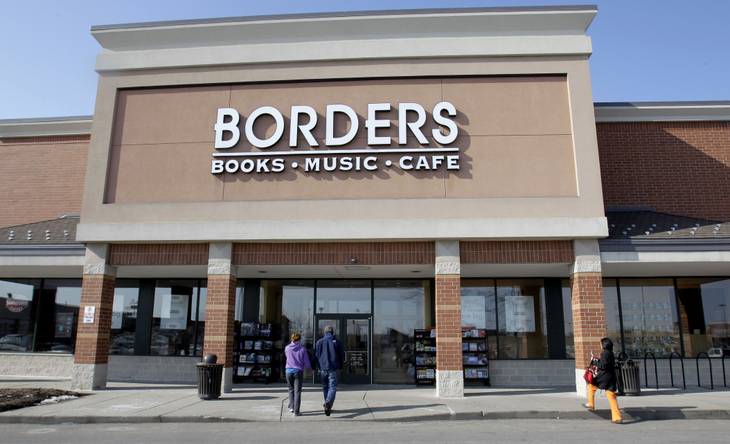
Customers walk into a Borders Books & Music store, in Ann Arbor, Mich. Borders Group filed for bankruptcy Monday, July 18, 2011, after seeking court approval to liquidate its 399 stores when the company failed to receive any bids that would keep the 40-year-old chain in operation.
Tuesday
19 July 2011
2 a.m.
J. Patrick Coolican
Sun archives
Related
The news that Borders Books will liquidate doesn’t just bring the loss of four big bookstores in the valley, public spaces where people could browse, relax and maybe even socialize with a neighbor.
The demise of Borders also indicates the flagging fortunes of the suburban big-box store model of development. In Henderson, the closed Borders will be just down Stephanie Street from the old Circuit City, which went through its own liquidation in early 2009. Despite prime retail space in an affluent area, the old Circuit City space remains unfilled, and I’d bet the Borders spot will be similarly vacant for a long time.
The coming problems with suburban big-box development are threefold, and they are worse in Las Vegas than almost anywhere else.
1) Young people want to live in an urban environment, not the big-box suburbs where they grew up. As I reported earlier this year, more than 80 percent of Americans born between the mid-1970s and 2000 would choose to live in an urban area, or a suburban area that qualified as “urban lite,” such as Arlington, Va., or Bethesda, Md, according to a consultant with the real estate firm RCLCO. (Arlington and Bethesda are suburbs that feature walkability and easy access to urban amenities.)
2) The days of mass affluence — when people went to the big-box stores and spent a little of their home equity or savings or whatever — appear to be finished. Americans, if they have a job at all, are de-leveraging — paying down debt. And who can blame them?
As an Advertising Age columnist alerted readers recently, the only people with real money to spend are the super rich. Only those who made $100,000 or more last year spent more than in the prior year. And that’s not the big-box store model.
3) Increasing use of the Internet to buy everything from books to electronics to apparel continues apace, eating into big-box store revenues.
This is a serious problem for Las Vegas because, all we did was build big-box retail and suburban living and office space, even as the country began moving back toward urbanism in the 1990s. We were building the wrong product.
Similarly, The Wall Street Journal reported recently that big city downtown office towers are bouncing back strongly while suburban office parks are being left behind. What did we spend 20 years building? A bunch of suburban office parks. Our office vacancy rate is currently more than 20 percent.
Las Vegas: Better weather than Detroit!
Share
Join the Discussion:
Previous Discussion:
Discussion 14 comments
Only trusted comments are displayed on this page. Untrusted comments have expired from this story.
Most Popular
- Higher dues for homeowners at stake in HOA legislation
- Gay adoptive parents live as a ‘normal family’ in Las Vegas but yearn for right to marry
- Boyd casinos drop the green flag on new NASCAR slot machine
- Las Vegas still leads U.S. in underwater homeowners, but crisis is subsiding
- Men arrested in death of teen during iPad robbery held without bail


These spaces will sit empty for a long, long time - UNLESS - someone starts applying some creative thinking RIGHT NOW. Unfortunately, the big banks and corporate interests that own these buildings aren't exactly known for their creative thinking.
They should gut these buildings and repurpose them as incubators, mini office parks, creative hubs, etc. It will take out of the box thinking to fill the box. I have little hope this will happen but it COULD happen. Another problem is that some of these buildings sit empty because their owners WANT them to sit empty. They can enjoy significant tax benefits by writing down the value of these buildings. Why else would their owners be asking for the same rents they got in 2007 at the height of the boom?
The majority of the population can't identify with a big-box monolith anymore. We want more value for our money and a business that cares about who we are as customers. Borders never got to know me or my community, so why should the community care for them. The jobs will come and go, but perhaps if they offered more than they took they wouldn't be going out of business. Going along with the rhythm devoid of personality and taking peoples money, with no grand experience, product or service in return is not how a business is going to survive in this new economy. The library managed to offer a better experience than Borders and not because it was free, but because it kept up with the changing technology.
Here in Bakersfield, an old Home base store (like Home Depot) is still vacant after close to 10 years. (It was a furniture outlet for a year or so about 5 years back). The nearby vacated Costco and Home Depot stores are also vacant. (both moved to new bigger locations nearby). The nearby closed Office Depot was made into a traffic court building (plenty of business there). The other Home Base building (also closed a decade ago) was an indor RV showroom for a bit, until RV sales tanked. They just tore it down to build a used car dealership. The closed Circuit City, 2 Mervyns, 2 Gottschalks, Comp USA and Target, Borders, etc. around town are all still vacant, along with a few former grocery stores and car dealerships. A lot of smaller retail lease space is also vacant. Montgomery Wards is now an indoor swap meet.
The old Zodys sat for decades before A Home Depot opened there. There's enough empty big boxes to last a long time. Of course, if something new comes to town, they'll build new....Someday they'll learn...
I think many of those stores are leasebacks, so they may not be owned directly by the retailers, maybe a REIT or a real estate company affiliated with the retailer. They are owned by "real estate specialists." but all they had to do over the last 40 years is find major retailers and sit back. They didn't need to do anything creative.
There are closed Sam Clubs, Walmarts around the country as well.
Some of the car and truck dealerships are wholesale vehicle auction sites now. There is only room for so many "incubators" and often there is a liability problem.
Remember the Chevy's across from Borders at W. Sahara? It was torn down and a new Chase Bank was built from the ground up.
Big box stores are being replaced with Internet warehouses. That Indoor Flea Market on Decatur is pretty empty as well, even though it might be a good place for a start-up.
Go to that local used book store on Charlston.
Chunky says:
The Vegas suburbs definitely lack a sense of local neighborhood / community, but frankly the town was not built on that philosophy from the beginning. It has been a town built on coming here for a growth period, make your mark or money and move on. Whether it was the dam, the original casino days, the mega-casino growth period or the housing boom, it always has been built for growth.
However, people do build lives, families and careers here. The problem is that building local neighborhoods and community takes time, effort and a certain mindset amongst the residents and community leaders. Chunky doesn't get a sense that too many people are selfless enough to invest in the relationships that make up that lifestyle. In a town full of overbearing HOAs who depersonalize the neighborhoods, no wonder the next-gens want to escape and find a place where they are not forced into a cookie cutter home, yard and paint color.
It's not just about what we build and where we built it, it's about the people behind it as well.
That's what Chunky thinks!
With the economy in the dumps and the valley possessing several public libraries where you can read or take books home to read for FREE why would anyone opt to spend 15 to 25 bucks [or more] on a book?
The demise of the bookstores...
Has as much to do with this machine I'm typing on as anything else.
Amazon, Kindle, Tablets and the like are taking a huge CHUNK out of the market.
The time has come where you don't need to ever leave your home to survive. Work, shop, play. It's all just a click away!!!
Pretty soon, we'll have to find ways to force some people to leave their homes to socialize.
There are already legions of "Internet Hermits."
Until brick and mortar stores are able to work on an equal plain with internet retailers, the Valley will see more and more store closings and lost jobs. As long as our sales tax creates a nearly ten percent penalty for having a brick and mortar store, the brick and mortar stores will slowly die out.
We need sales tax reform. Either charge internet retailers the tax, or exempt brick and mortar retailers, but at least make the playing field equal.
I blame myself and gmag39 for Borders demise. To me, the death of this store has nothing to do with "next-gens" or any other sappy euphemism for a human in our society.
I blame it on technology. I have been puchasing and reading books published in an electronic format since 1999 when I owned a Palm Pilot with 128mb capacity. I purchased books on-line from Peanut Press....currently I own a tablet with 32gb capacity loaded with Kindle, Borders, ereader, Sony reader, Nook and Kobo apps that I read with. Not to mention dedicated PDF readers.
I like the portability of the electronic form factor as well as readability. I am in common parlance, a book "junkie". I love to read.
I agree somewhat with the demise of big box stores being a matter of over-growth but it is hard to argue that a mega shopping center loaded with varieties is a shoppers nirvana.
So the hipsters, hucksters and phonies can't park their fixies while pretending to be urban surrealists..... so what.
Borders did themselves in. Most everything in their store and on their site was sold at list price. Why should I go to Borders and pay list price when I can get it cheaper at Amazon or maybe even B&N? Their refusal to offer sales and good values led them to the position they are in now. I'm curious to see exactly what their "liquidation sales" will offer.
"the only people with real money to spend are the super rich. Only those who made $100,000 or more last year spent more than in the prior year."
Are you suggesting that households that earned $100k are "super rich"? Wow. I mean, w-o-w.
Aside from that odd sense of income reality, as someone who grew up in bookstores and libraries, it is "sad" (more for nostalgia's sake than anything) that bookstores are disappearing.
But when you can send one iPad loaded with 500 books to a 3rd world reading program for the same cost as sending 50 printed books, I think the writing is on the wall -- especially when the biggest benefactors of those reading programs are already moving that direction. Education makes up the vast bulk of printed book buying, and with the so-called "greening" of campuses worldwide, publishers are losing more and more of the largest buyers of printed books each semester. So, in essence, one can blame the "green movement" for at least part of this. It is, however, the simple march of technology.
If there is anything one can learn in Las Vegas (and there is plenty), it is adapt or die. Those who saw the eventual demise of the suburbs coming already made their move to the center of town; at some point in the future, the urban areas will plateau and there will be new models of city living devised.
Change is the only constant, especially here. Acknowledge, move on. Or, waste time wringing your hands.
It's the end of an era now that it's just too easy to find reading material online.
I will miss book stores. Walking in book stores always gave me a feeling of hope and possibility through discovery. Like there was something in there I would find - a book, magazine or piece of music - that would change my perspectives in a positive way. Those discoveries did happen, more times than not.
I wonder what will happen to all the people that would park themselves in the coffee shop portion of the store, reading magazines and books, as if Borders were a library. I was always stunned that these people enjoyed all store's resources without paying for them, without recourse from anyone at Borders.
I wonder if Barnes & Noble is getting ready to welcome more of these book store barnacles, now that they have fewer places to go.
It is hard to feel any sense of nostalgia for an anitseptic box selling books for far more than its competitors.
I guess will could bulldoze all the strip shopping centers and they can revert to desert.
Why is Las Vegas always playing "catch up"? It seems to me that all the people making the management decisions for the city are incompetent. The casino industry has tried to lead the way but because of greed and infighting they have failed. Our city is disjointed, disorganized, and disconnected from it's citizens. What do our leaders think the answer is? Simple... add a few ferris wheels. What the deuce man?
I wish I could just retire now, tune out, and move to a place like bisbee, az. the hell with vegas and most uppity urban/suburban centers anyway. I've seen enough and am beyond not impressed.
Remenber when Borders and B&N came to town, All of the articles on the subject, around the country predicted (correctly) the demise of the smaller, local (real) bookstores, where the store owner was likely to ring up your sale, and could order whatever you wanted, and have it in a day or 2, if it wasn't in stock. Same thing happened with local toy and hobby stores, also appliance stores when the large stores came to town.
Service used to matter, now it's "I can get it at big box for a little less", with most folks not wanting the "cheapest" (now made in China) whatever.
@James Reza..you're dead on. Lumping people or famalies that bring in over $100K / year as "super rich" is one of the most riduculous things I've ever seen written. I've always considered being rich was making maybe half a million a year. I would of said Tiger Woods is super rich, not a couple pulling in $50K each a year.
People here aren't going to have much money so its inevitable most of these stores will close or flat leave the state. This is probably going to happen nationwide, not just in Vegas. Its the toilet bowl effect.
Even when I have money now a days, I don't want to buy anything. Everything constantly breaks or is designed to break so why bother? Everything is made in China. As far as products go, most are pretty boring. How many cell phones can you buy before you just stop caring about the little upgrade they added. How many commercials do you sit through before you cancel tv. How many times do you get bad service at restaurants before you stop going?
Ive gotten to the point where I am literally scared to buy anything because I don't feel like being annoyed. Literally.
But what annoys me most, is these massive corporations, like borders, put small business book stores out of business. These were people who actually cared about books, reading, and their business. But since corporations come along, they get put out of business because they cant compete.
Now what are we left with? We have no book stores. Wonderful.
Couple people have misread this paragraph:
As an Advertising Age columnist alerted readers recently, the only people with real money to spend are the super rich. Only those who made $100,000 or more last year spent more than in the prior year.
These are two separate facts. I never claimed 100k equaled "super rich."
Mr. Coolican:
The statement by Advertising Age is subjective, not factual. I realize you placed a link to the AA story within the sentence, but not everyone has the time to meta-read.
For my money, that paragraph remains confusing, and still implies that $100k is super rich. Rather than tell us what you didn't mean, why not simply clarify the intent of the paragraph, for the readers' sake?
More than anything, technology killed Borders, not poor city planning. Big box stores can pose challenges for any city; "Las Vegas" isn't the reason every time a "problem" is uncovered, and socio-economic engineering via government (in this case, zoning) isn't always the solution.
Respectfully,
JPR
$100k a year might not be "super" rich, but most of us making half of that would like to give it a try. Until the economy turns, $40-$60k is a very decent living for most of us. An extra 50k (30 after taxes) would go a long way. In 2005, when the building boom was going on, a lot of us in that industry were making 80 with overtime and bonuses. The bonuses went in 2006, the overtime went in 2007, the job went in 2008. But I'm surviving, thanks to prudent (cheap) lifestyle when times were good.
Bakersfield, I wish more people around here were like you. Seems like many assumed the overtime and the bonuses would last forever. Now they are broke, their house is in foreclosure, and they are draining the government of its limited resources.
As usual, James P. Reza gets it wrong. The sentences in question were clear enough; only Reza got confused, due to not "meta-reading," whatever that gobbledygoook excuse is supposed to mean.
Meanwhile, as Bakersfield alludes, for most American households $100K a year income would be grand indeed. I forget the exact numbers, but average household income in this nation is $46 or $48K'ish. We've given away the store to East and Southeast Asia without requiring equal access to their economies. U.S. incomes in real dollars have been going down. The Countrywide/Oscar Goodman construction and credit bubble masked the shrinkage for a while, but now it's impossible to ignore: our American economy is failing the middle class. Poor stewardship -at both the federal and state levels, as well as at the local level (as described in this article) has allowed massive waste, misdirection and destruction of capital. Now all we have is ugly empty boxes all over the valley to show for it. This includes all the ugly new empty boxes clogging up Downtown Las Vegas. Write small, Las Vegas represents much of the ills of America.
Correction: "Writ small..."